Why a Running Order Does More Than Keep Time
A running order shapes a variety program’s identity by balancing distinct acts, audience expectations, and a satisfying arc from the first appearance to the last.
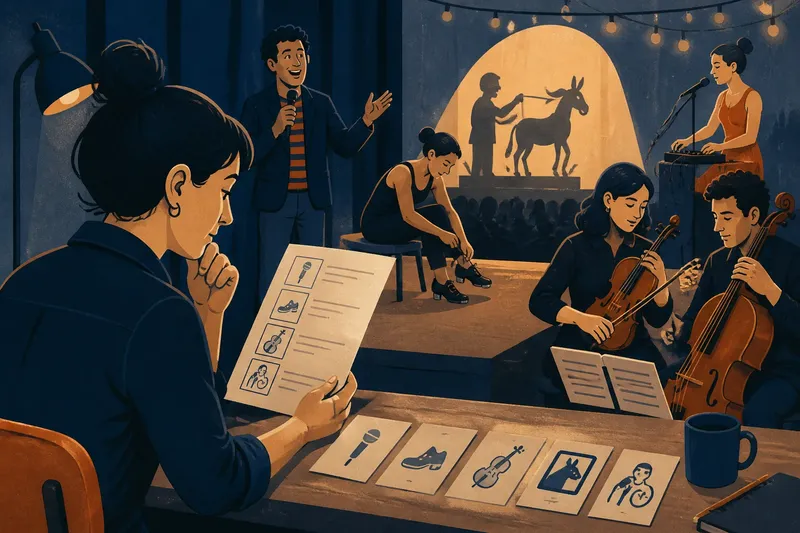
A host at a small theater glances at a running order while performers wait in the wings. The comic is ready, the tap dancer is lacing shoes, and a string duo is checking its instruments. The minutes fit, but the program still feels like a stack of unrelated acts. A variety show’s running order can give those acts a shared identity without making them alike.
Consider an invented situation: Mara, a producer at the fictional Harbor Room, is assembling a single-evening bill with a comic, a tap dancer, a string duo, a shadow-puppet artist, and a singer who performs with a loop pedal. Her first draft follows the order in which the performers confirmed. To revise it, she asks what kind of evening the venue wants to present and what the audience should remember when it leaves.
What does a running order shape besides time?
A running order is the order in which a program’s elements appear. For a variety show, those elements might include performers, a host’s brief links, and a pause for a stage change. The sequence does more than arrange entrances: it suggests what kind of show this is, which acts belong together, and what thread connects different performance styles.
Think of the order like a shelf displaying objects from a collection. A group of unrelated objects can look intentional when their colors or forms have been considered together. Likewise, distinct acts can make a coherent bill if their placement gives the audience a way to understand the evening as a whole.
That thread might be a shared theme, a recurring visual motif, a host’s perspective, or a progression in tone. It does not need to be announced. It should, however, be specific enough to help the producer decide whether a proposed act strengthens the program’s identity or pulls it in an unrelated direction.
How can the acts express one idea without becoming repetitive?
Mara’s fictional venue has chosen “small surprises” as the program’s loose theme. The phrase gives her a useful editorial test, not a rule that every performer must interpret it in the same way. The comic can build a joke around an unexpected detail; the puppet artist can reveal a hidden image; the singer can add new layers to a simple opening sound.
Each act still needs its own character. If every performer uses the same visual style or makes the same kind of joke, the theme may feel like a restriction rather than a connection. Mara looks for different interpretations of the idea, then places them where each can be recognized on its own terms.
She also checks that the theme is legible without a long explanation. If the audience needs a paragraph of context before each act, the concept may be too complicated for the format. A concise program note or a host’s natural introduction can offer a clue, but the performances should carry most of the meaning.
How should the opening and ending support the program’s identity?
The opening gives the audience its first clue about the evening. It might establish a playful tone, introduce a recurring image, or make the show’s central idea clear through a recognizable performance. It need not be the biggest act. A complicated opener can delay the audience’s understanding of what kind of event it has entered.
The ending can bring the program’s idea into focus. Mara considers closing with the loop-pedal singer because the act can begin with a bare vocal line and gradually add sounds. That structure fits the evening’s theme of small surprises. Another bill might close with a quiet image or a comic callback; the choice depends on what gives that particular program a satisfying final meaning.
Opening and ending are easier to judge as a pair. If the first act introduces an idea that the final act revisits in a new form, the audience can sense a relationship across the bill. The connection may be subtle, but it should feel earned rather than attached only in the host’s closing remarks.
What should Mara check before settling the order?
- Check whether each act supports the program’s theme; if it offers a clear interpretation, keep it in consideration, but if it feels unrelated, revise the framing or choose a different act.
- Check whether neighboring acts repeat the same style; if their shared qualities create a deliberate sequence, keep them together, but if they blur into one another, separate them.
- Check whether the opening makes the evening’s identity easy to grasp; if it does, retain it, but if it needs extensive explanation, choose a clearer entry point.
- Check whether the ending brings a theme or image back in a fresh way; if it does, keep it as a candidate closer, but if it feels disconnected, choose an ending with a stronger relationship to the bill.
- Check whether each performer can work within the venue’s stage setup; if the act fits the available arrangement, keep its placement flexible, but if it needs a distinct setup, place it where that change makes sense.
- Check whether the host’s introductions add context the audience needs; if a short link clarifies a connection, retain it, but if the link merely explains what the performance already shows, trim it.
Imagine Mara has three draft elements written on cards: the comic’s surprise-based set, the shadow-puppet artist’s reveal of an image, and the singer’s gradual layering of sounds. She puts them in that order and asks whether the theme becomes clearer with each act. The comic introduces the idea, the puppetry turns it into a visual reveal, and the singer makes it accumulate through sound. Mara keeps the sequence, but places the string duo between the comic and puppetry because its reflective mood gives the audience a different way to experience the theme. The resulting program has a recognizable thread without repeating one format.
Which questions help resolve common ordering choices?
Should similar acts be placed together?
They can be grouped when their shared style creates a purposeful passage through the show. If their similarities make one act hard to distinguish from the next, separate them or give each a different relationship to the program’s theme.
Does a quieter act need a quiet position?
Not necessarily. A focused performance can offer a useful change in tone after a lively turn, provided the audience can understand why the shift belongs in the program.
Should the strongest act always close?
Strength depends on the program’s purpose. A technically demanding performance may need a place where it can be appreciated on its own, while the closer might be chosen for the way it completes a theme or leaves a memorable image.
What if a performer needs a particular stage arrangement?
Include that need while shaping the sequence. If a performance depends on darkness, projection, or a clear floor, place it where the program can accommodate that setup without making the act seem incidental.
How can the program stay coherent while the lineup changes?
Live bills can change when an act withdraws or a venue adjusts its plans. Mara keeps the program’s identity flexible by describing it through a few plain ideas rather than a single indispensable performer. If the puppet artist becomes unavailable, she can look for another act that offers an element of reveal, rather than trying to preserve the exact same sequence.
For each replacement, she asks what role the missing act served. Did it introduce the theme, provide a contrasting mood, or create a visual moment? The answer helps her select a substitute and decide where it belongs. This is different from moving names around until the list looks balanced: the producer is preserving the program’s meaning while adapting its ingredients.
The running order is not a cue sheet or a crew’s operational document. Those tools handle detailed production information. The running order’s editorial purpose is to make the audience’s experience of the acts feel intentional, even when the lineup or practical arrangements shift.
What makes the final program feel like one event?
Coherence comes from relationships the audience can recognize: a shared idea, a contrast that has a purpose, or an opening and ending that speak to each other. Mara’s fictional bill keeps its performers distinct while letting “small surprises” echo through comedy, puppetry, music, and the final layered song.
Before she settles the order, Mara checks that the theme is clear without a speech, that each act has room to be itself, and that the closing moment belongs to the evening she has created. The main search phrase, running order for a variety program, is useful to remember here: the order is an editorial choice that can give a mixed bill a character beyond its list of performers.
A practical final check is to describe the show in one plain sentence, then compare that sentence with the acts on the page. If the description fits the program without stretching, the lineup has a readable identity; if it does not, the producer can revise the theme, the order, or the selection before the audience arrives.