Your First Variety Night: Make One Act Your Anchor
A first variety night feels easier when one act gives the evening a center. Choose an anchor, then enjoy the rest without pressure to love everything.
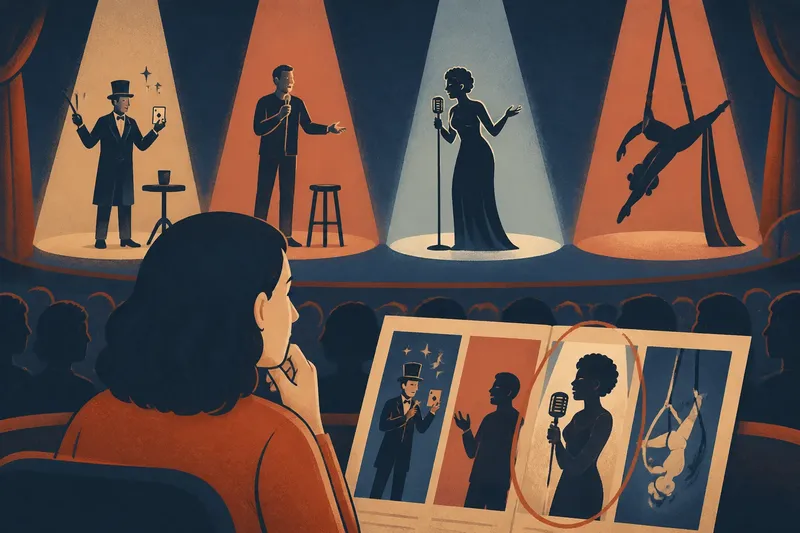
You have a ticket for a variety night, but the program lists a magician, a comic, a singer, and an aerial act you have never seen. Picking one act to anticipate gives the evening a center without turning the rest into homework. For your first variety night, an anchor is simply the performance you most want to experience.
That choice can ease the small uncertainties of attending a mixed bill: what to expect, how to react when styles change, and whether you need to enjoy every performer. You do not. Treat the anchor like a familiar lamp in a room with new furniture: it helps you get your bearings, while the rest of the room can still surprise you.
What does an anchor act do for your evening?
An anchor act is one appearance on the program that gives you a personal reason to look forward to the show. It might be a comedian whose short clips made you curious, a singer whose style you already enjoy, or a circus performer whose skill you want to see live. You are not choosing the “best” act on the bill or predicting how the audience will respond. You are choosing your own point of interest.
That distinction matters because variety shows are built to change texture. A polished song can be followed by an awkwardly funny monologue; a quiet story may lead into a loud dance number. The transitions are part of the evening, but they can feel abrupt if you arrive expecting one continuous mood. An anchor gives you something specific to anticipate amid those shifts.
It also sets a gentle boundary around your expectations. If one act is the reason you bought a ticket, you can count the night as worthwhile even if another style is not for you. If several acts delight you, that is a bonus rather than an obligation.
Should you choose the familiar act or the unknown one?
There are three useful approaches, and none is universally right. Choose based on what makes a live evening feel comfortable and engaging for you.
Choose a familiar performer if predictability helps you settle in
You may recognize a singer, comic, or dance company from earlier work and know that its style usually holds your attention. Familiarity can make the first visit feel less uncertain: you have a clear reference point, and you can notice how the performance changes in a room with a live audience.
This option suits someone who likes to arrive with a modest expectation already in mind. Keep it flexible, though. A short variety slot may differ from a full-length performance, and the room, sound, or format can change the feel. Let recognition be a reason to look forward to the act, not a promise that it will match another appearance.
Choose an unfamiliar act if curiosity is your main pleasure
Perhaps a performer’s description catches your eye, even though you do not know the work. An unfamiliar act can be a good anchor if you enjoy discovering a new style in a low-stakes setting. You can watch for one detail—a surprising instrument, a change in movement, or the way a performer uses silence—without needing to decide immediately whether you like the whole act.
This approach suits an audience member who enjoys uncertainty more than reassurance. It may be less comfortable if you feel you must understand every reference or technique. You can simply attend to what is visible and audible, then let your response stay open.
Choose the act shared with your companion if the outing is social
If you are attending with a friend, your anchor can be the act you are both curious about. That gives you a natural point to talk about afterward without requiring agreement on every performance. If your tastes differ, choose one person’s pick as the shared anchor this time, and leave room for each of you to claim a different favorite later.
This option works well when the company matters as much as the bill. It is less useful if choosing together becomes a negotiation over whose preference counts. In that case, each person can keep a private anchor and enjoy the night side by side.
How do you choose an anchor before you arrive?
Use the information the venue already provides, such as a program, ticket page, or short performer description. You do not need to research every act. Scan for the names and forms that catch your attention, then choose one with a clear personal reason: “I want to hear that singer live,” or “I’m curious about how a close-up magician works onstage.”
Say you are considering a bill with a comic, a jazz vocalist, and a physical theater duo. Imagine that the vocalist’s style interests you most, but you have never heard the duo. Make the vocalist your anchor, and decide that you will give the duo your attention as a separate discovery. The observable result you can aim for is simple: you arrive with one thing to anticipate and still have room to notice what else holds your attention.
Do not turn the choice into a ranking exercise. The amount of information available about an act does not tell you how much you will enjoy seeing it live. A brief description may be enough; if you remain unsure, pick the act whose format sounds most appealing rather than trying to forecast your reaction.
What should you expect from the rest of the bill?
Think of the other acts as invitations, not tests. A variety program may include forms you know well and others you have not encountered. You can follow the basic shape of each performance: a story being told, a musical idea developing, a physical feat being attempted, or a comic premise being built. Understanding the form is not a condition for enjoying it.
Audience customs also vary by act and venue. Applause may come between pieces or at the close; laughter may overlap a comic’s next line; a quiet moment may be part of a song or a spoken performance. Follow the room’s lead rather than worrying about having the perfect response. A sincere, ordinary reaction is enough.
If one act does not connect with you, you do not need to diagnose why. Stay courteous, give the performer your attention, and let the next change of style reset the evening. A mixed bill offers different kinds of performance precisely because one mood does not suit every person in the room.
How can you make the evening comfortable?
Before going, check the venue’s own information for practical details such as entry arrangements, seating, late arrival guidance, and any accessibility options you may need. If you are unsure about a specific accommodation, contact the venue directly. Arriving with the basic logistics settled leaves more attention for the show.
Once seated, give yourself permission to watch rather than document every moment. A phone can distract you from a brief gesture or a shift in the room, and recording may be restricted by the venue or performer. If you want to remember the bill, keep the program or make a note after the show instead.
If you need to step out, use the venue’s guidance and move quietly when appropriate. You are not required to remain in your seat at any cost, and you are not required to leave merely because one act is not your taste. Make the choice that respects both your needs and the people performing.
Which approach fits you best?
Choose a familiar act if reassurance helps you settle. Choose an unfamiliar one if discovery is what you enjoy. Choose a shared pick if conversation and companionship are central to the outing. If two options appeal, use the one that gives you a clear, uncomplicated reason to look forward to the night.
What if I do not know any of the performers? Look for a description that names a form you enjoy, such as live music, physical comedy, or illusion. If none stands out, choose the act whose format makes you curious and treat the rest as open possibilities.
What if my anchor is disappointing? Let that response be about the performance you saw, not a verdict on the whole evening. Another act may suit you better, and you can still appreciate the parts of the show that work for other audience members.
Can I have more than one anchor? You can, especially if two acts appeal for different reasons. But if the choice starts to feel like a list of expectations, return to one main act and let the others remain potential discoveries.
Do I need to understand every kind of performance? No. Notice what the act asks you to watch or listen for, and give it a fair moment. Your response can be interest, amusement, admiration, or simply a sense that the style is not for you.
What is worth carrying home?
After the show, remember the anchor as a starting point, not a scorecard. Perhaps it was the act you anticipated; perhaps an unexpected performer stayed with you more. Either outcome tells you something useful about what you like seeing live.
For a first variety night, choosing an anchor makes the experience easier to enter without narrowing it. The next time you see a mixed bill, you can choose a different kind of anchor—or arrive with no particular favorite at all. The point is not to predict the evening. It is to give yourself one reason to look forward to it, then let the room offer the rest.